


Modifications of the Hazard Communication Standard to Global Harmonization System (GHS)
Q. What is the Globally Harmonized System?
A. The Globally Harmonized System (GHS) is an international approach to
hazard communication, providing agreed criteria for classification of
chemical hazards, and a standardized approach to label elements and safety
data sheets. The GHS was negotiated in a multi-year process by hazard
communication experts from many different countries, international organizations,
and stakeholder groups. It is based on major existing systems around the
world, including OSHA's Hazard Communication Standard and the chemical
classification and labeling systems of other US agencies.
The result of this negotiation process is the United Nations' document
entitled "Globally Harmonized System of Classification and Labeling
of Chemicals," commonly referred to as The Purple Book. This document
provides harmonized classification criteria for health, physical, and
environmental hazards of chemicals. It also includes standardized label
elements that are assigned to these hazard classes and categories, and
provide the appropriate signal words, pictograms, and hazard and precautionary
statements to convey the hazards to users. A standardized order of information
for safety data sheets is also provided. These recommendations can be
used by regulatory authorities such as OSHA to establish mandatory requirements
for hazard communication, but do not constitute a model regulation.
Q. Why did OSHA decide to modify the Hazard Communication Standard
to adopt the GHS?
A. OSHA has modified the Hazard Communication Standard (HCS) to adopt
the GHS to improve safety and health of workers through more effective
communications on chemical hazards. Since it was first promulgated in
1983, the HCS has provided employers and employees extensive information
about the chemicals in their workplaces. The original standard is performance-oriented,
allowing chemical manufacturers and importers to convey information on
labels and material safety data sheets in whatever format they choose.
While the available information has been helpful in improving employee
safety and health, a more standardized approach to classifying the hazards
and conveying the information will be more effective, and provide further
improvements in American workplaces. The GHS provides such a standardized
approach, including detailed criteria for determining what hazardous effects
a chemical poses, as well as standardized label elements assigned by hazard
class and category. This will enhance both employer and worker comprehension
of the hazards, which will help to ensure appropriate handling and safe
use of workplace chemicals. In addition, the safety data sheet requirements
establish an order of information that is standardized. The harmonized
format of the safety data sheets will enable employers, workers, health
professionals, and emergency responders to access the information more
efficiently and effectively, thus increasing their utility.
Adoption of the GHS in the US and around the world will also help to improve
information received from other countries-since the US is both a major
importer and exporter of chemicals, American workers often see labels
and safety data sheets from other countries. The diverse and sometimes
conflicting national and international requirements can create confusion
among those who seek to use hazard information effectively. For example,
labels and safety data sheets may include symbols and hazard statements
that are unfamiliar to readers or not well understood. Containers may
be labeled with such a large volume of information that important statements
are not easily recognized. Given the differences in hazard classification
criteria, labels may also be incorrect when used in other countries. If
countries around the world adopt the GHS, these problems will be minimized,
and chemicals crossing borders will have consistent information, thus
improving communication globally.
Q. What is the phase-in period in the revised Hazard Communication
Standard?
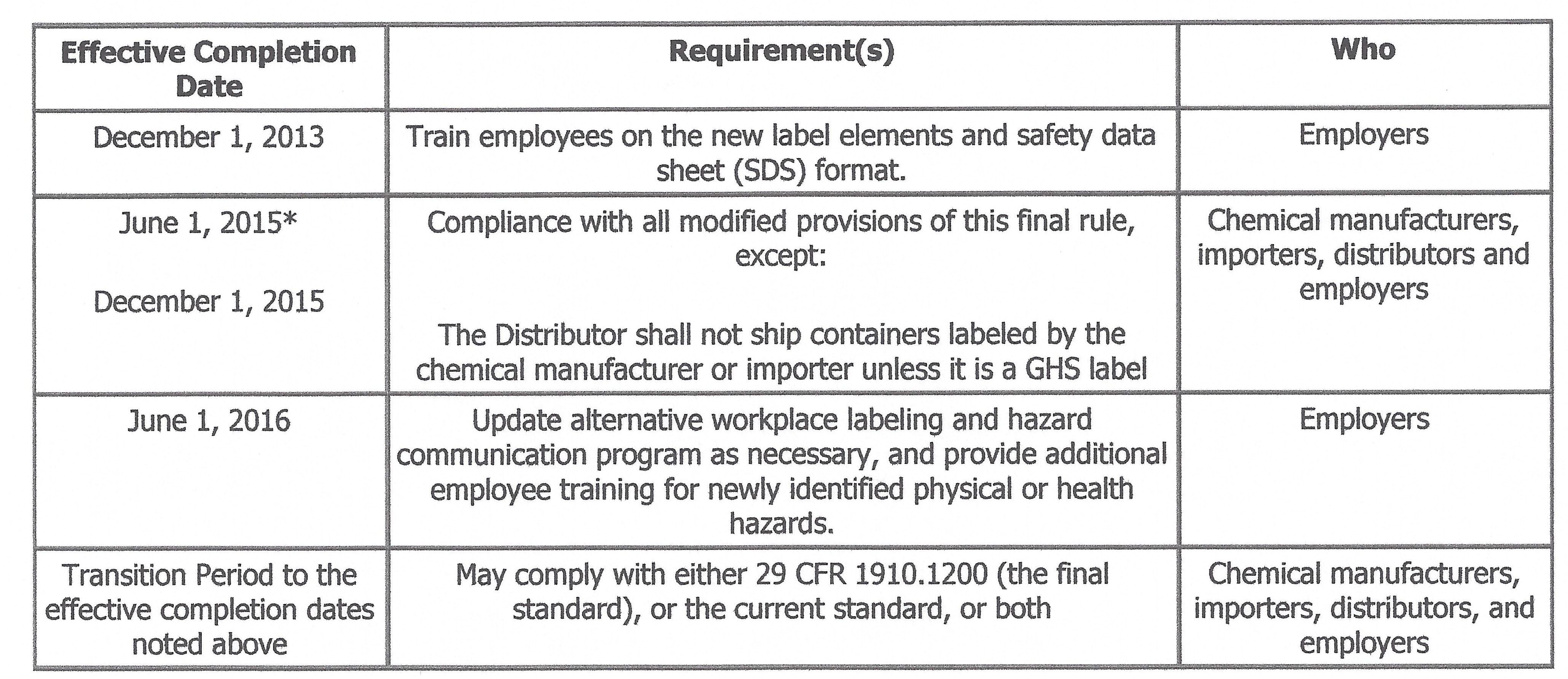
A. The table below summarizes the phase-in dates required under the revised
Hazard Communication Standard (HCS):
Q. Why must training be conducted prior to the compliance effective
date?
A. OSHA is requiring that employees are trained on the new label elements
(e.g., pictograms and signal words) and SDS format by December 2013, while
full compliance with the final rule will begin in 2015. While many countries
are in various stages of implementing the GHS, OSHA believes that it is
possible that American workplaces may begin to receive labels and SDSs
that are consistent with the GHS shortly after publication. Thus, making
it important to ensure that when employees begin to see the new labels
and SDSs in their workplaces, they will be familiar with them, understand
how to use them, and access the information effectively.
Q. What are the major changes to the Hazard Communication Standard?
A. The three major areas of change are in hazard classification, labels,
and safety data sheets.
- Hazard classification: The definitions of hazard have been changed to provide specific criteria for classification of health and physical hazards, as well as classification of mixtures. These specific criteria will help to ensure that evaluations of hazardous effects are consistent across manufacturers, and that labels and safety data sheets are more accurate as a result.
- Labels: Chemical manufacturers and importers will be required to provide a label that includes a harmonized signal word, pictogram, and hazard statement for each hazard class and category. Precautionary statements must also be provided.
- Safety Data Sheets: Will now have a specified 16-section format.
The GHS does not include harmonized training provisions, but recognizes that training is essential to an effective hazard communication approach. The revised Hazard Communication Standard (HCS) requires that workers be re- trained within two years of the publication of the final rule to facilitate recognition and understanding of the new labels and safety data sheets. For a side-by-side comparison of the current HCS and the final revised HCS please see OSHA's hazard communication safety and health topics webpage at: http://www.osha.gov/dsg/hazcom/index.html
Q. What Hazard Communication Standard provisions are unchanged in
the revised HCS?
A. The revised Hazard Communication Standard (HCS) is a modification to
the existing standard. The parts of the standard that did not relate to
the GHS (such as the basic framework, scope, and exemptions) remained
largely unchanged. There have been some modifications to terminology in
order to align the revised HCS with language used in the GHS. For example,
the term "hazard determination" has been changed to "hazard
classification" and "material safety data sheet" was changed
to "safety data sheet." OSHA stakeholders commented on this
approach and found it to be appropriate.
Q. How will chemical hazard evaluation change under the revised Hazard
Communication Standard?
A. Under both the current Hazard Communication Standard (HCS) and the
revised HCS, an evaluation of chemical hazards must be performed considering
the available scientific evidence concerning such hazards. Under the current
HCS, the hazard determination provisions have definitions of hazard and
the evaluator determines whether or not the data on a chemical meet those
definitions. It is a performance-oriented approach that provides parameters
for the evaluation, but not specific, detailed criteria. The hazard classification
approach in the revised HCS is quite different. The revised HCS has specific
criteria for each health and physical hazard, along with detailed instructions
for hazard evaluation and determinations as to whether mixtures or substances
are covered. It also establishes both hazard classes and hazard categories-for
most of the effects; the classes are divided into categories that reflect
the relative severity of the effect. The current HCS does not include
categories for most of the health hazards covered, so this new approach
provides additional information that can be related to the appropriate
response to address the hazard. OSHA has included the general provisions
for hazard classification in paragraph (d) of the revised rule, and added
extensive appendixes (Appendixes A and B) that address the criteria for
each health or physical effect.
Q. How will labels change under the revised Hazard Communication Standard?
A. Under the current Hazard Communication Standard (HCS), the label preparer
must provide the identity of the chemical, and the appropriate hazard
warnings. This may be done in a variety of ways, and the method to convey
the information is left to the preparer. Under the revised HCS, once the
hazard classification is completed, the standard specifies what information
is to be provided for each hazard class and category. Labels will require
the following elements:
- Pictogram: a symbol plus other graphic elements, such as a border, background pattern, or color that is intended to convey specific information about the hazards of a chemical. Each pictogram consists of a different symbol on a white background within a red square frame set on a point (i.e. a red diamond). There are nine pictograms under the GHS. However, only eight pictograms are required under the HCS.
- Signal words: a single word used to indicate the relative level of severity of hazard and alert the reader to a potential hazard on the label. The signal words used are "danger" and "warning." "Danger" is used for the more severe hazards, while "warning" is used for less severe hazards.
- Hazard Statement: a statement assigned to a hazard class and category that describes the nature of the hazard(s) of a chemical, including, where appropriate, the degree of hazard.
- Precautionary Statement: a phrase that describes recommended measures to be taken to minimize or prevent adverse effects resulting from exposure to a hazardous chemical, or improper storage or handling of a hazardous chemical.
Q. What pictograms are required in the revised Hazard Communication
Standard? What hazard does each identify?
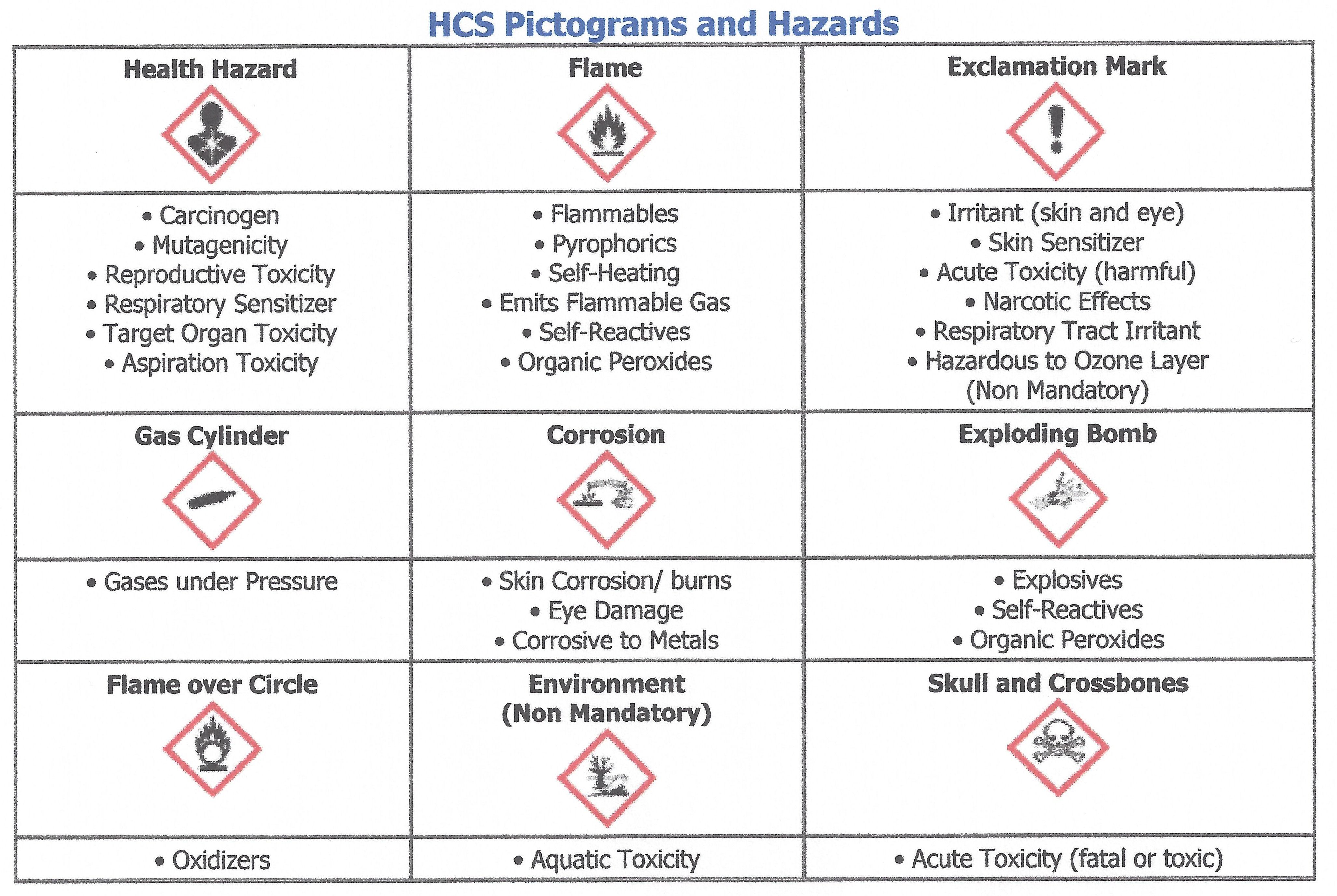
A. There are nine pictograms under the GHS to convey the health, physical
and environmental hazards. The final Hazard Communication Standard (HCS)
requires eight of these pictograms, the exception being the environmental
pictogram, as environmental hazards are not within OSHA's jurisdiction.
The hazard pictograms and their corresponding hazards are shown below.
Q. Will OSHA allow blank red borders?
A. The revised Hazard Communication Standard (HCS) requires that all red
borders printed on the label have a symbol printed inside it. If OSHA
were to allow blank red borders, workers may be confused about what they
mean and concerned that some information is missing. OSHA has determined
that prohibiting the use of blank red borders on labels is necessary to
provide the maximum recognition and impact of warning labels and to ensure
that users do not get desensitized to the warnings placed on labels.
Q. When must label information be updated?
A. In the revised Hazard Communication Standard (HCS), OSHA is lifting
the stay on enforcement regarding the provision to update labels when
new information on hazards becomes available. Chemical manufacturers,
importers, distributors, or employers who become newly aware of any significant
information regarding the hazards of a chemical shall revise the labels
for the chemical within six months of becoming aware of the new information,
and shall ensure that labels on containers of hazardous chemicals shipped
after that time contain the new information. If the chemical is not currently
produced or imported, the chemical manufacturer, importer, distributor,
or employer shall add the information to the label before the chemical
is shipped or introduced into the workplace again.
Q. How will workplace labeling provisions be changing under the revised
Hazard Communication Standard?
A. The current standard provides employers with flexibility regarding
the type of system to be used in their workplaces and OSHA has retained
that flexibility in the revised Hazard Communication Standard (HCS). Employers
may choose to label workplace containers either with the same label that
would be on shipped containers for the chemical under the revised rule,
or with label alternatives that meet the requirements for the standard.
Alternative labeling systems such as the National Fire Protection Association
(NFPA) 704 Hazard Rating and the Hazardous Material Information System
(HMIS) are permitted for workplace containers. However, the information
supplied on these labels must be consistent with the revised HCS, e.g.,
no conflicting hazard warnings or pictograms.
Q. How is the Safety Data Sheet (SDS) changing under the revised Hazard
Communication Standard?
A. The information required on the safety data sheet (SDS) will remain
essentially the same as that in the current standard. The current Hazard
Communication Standard (HCS) indicates what information has to be included
on an SDS but does not specify a format for presentation or order of information.
The revised HCS requires that the information on the SDS is presented
using consistent headings in a specified sequence.
Paragraph (g) of the final rule indicates the headings of information
to be included on the SDS and the order in which they are to be provided.
In addition, Appendix D indicates what information is to be included under
each heading. The SDS format is the same as the ANSI standard format which
is widely used in the U.S. and is already familiar to many employees.
The format of the 16-section SDS should include the following sections:
Section 1. Identification
Section 2. Hazard(s) identification
Section 3. Composition/information on ingredients
Section 4. First-Aid measures
Section 5. Fire-fighting measures
Section 6. Accidental release measures
Section 7. Handling and storage
Section 8. Exposure controls/personal protection
Section 9. Physical and chemical properties
Section 10. Stability and reactivity
Section 11. Toxicological information
Section 12. Ecological information
Section 13. Disposal considerations
Section 14. Transport information
Section 15. Regulatory information
Section 16. Other information, including date of preparation or last revision
Sections 12-15 may be included in the SDS, but are not required by OSHA.
Q. How has OSHA addressed hazards covered under the current Hazard
Communication Standard that have not been addressed by the GHS?
A. In the Notice of Proposed Rulemaking (NPRM), OSHA proposed to include
hazards currently covered under the Hazard Communication Standard (HCS)
that have yet to be addressed by the GHS (OSHA provided several examples:
simple asphyxiants, and combustible dust) in a separate category called
"Unclassified Hazards". In response to comments from the regulated
community, OSHA has renamed the category to "Hazards Not Otherwise
Classified (HNOC)" to minimize confusion. In the final HCS, HNOC
hazards will not be required to be disclosed on the label but will be
required to be disclosed in section 2 of the Safety Data Sheet (SDS).
This reflects how GHS recommends these hazards should be disclosed. Chemical
manufacturers and importers are expected to assess these hazards when
they are conducting their hazard evaluation of physical and health hazards.
A new or separate evaluation is not required. Also in the final standard,
in response to comments, OSHA has removed pyrophoric gases, simple asphyxiants,
and combustible dust from the HNOC hazard category and has addressed these
chemicals individually (see question below for more information on each
hazard).
Q. How has OSHA addressed pyrophoric gases, simple asphyxiants, and
combustible dust?
A. In the revised Hazard Communication Standard (HCS), OSHA has added
pyrophoric gases, simple asphyxiants and combustible dust to the definition
of "hazardous chemical". OSHA has also added definitions to
the revised HCS for pyrophoric gases and simple asphyxiants, and provided
guidance on how to define combustible dust for the purposes of complying
with the HCS.
- Pyrophoric gases: OSHA has retained the definition for pyrophoric gases from the current HCS. Pyrophoric gases must be addressed both on container labels and SDSs. OSHA has provided label elements for pyrophoric gases which include the signal word "danger" and the hazard statement "catches fire spontaneously if exposed to air".
- Simple asphyxiants: OSHA has revised the definition of simple asphyxiants that was proposed in the Notice of Proposed Rulemaking (NPRM) as a result of comments from the regulated community. In the final HCS, simple asphyxiants must be labeled where appropriate, and be addressed on SDSs. OSHA has provided label elements for simple asphyxiants which include the signal word "warning" and the hazard statement "may displace oxygen and cause rapid suffocation".
- Combustible dust: OSHA has not provided a definition for combustible dust to the final HCS given ongoing activities in the specific rulemaking, as well as in the United Nations Sub-Committee of Experts on the GHS (UN/SCEGHS). However, guidance is being provided through existing documents, including the Combustible Dust National Emphasis Program Directive CPL 03-00-008, which includes an operative definition, as well as provides information about current responsibilities in this area. In addition, there are a number of voluntary industry consensus standards (particularly those of the NFPA) that address combustible dust.
In the final HCS, combustible dust hazards must be addressed on labels and SDSs. Label elements are provided for combustible dust in the final HCS and include the signal word "warning" and the hazard statement "May form combustible dust concentrations in the air".
For chemicals in a solid form that do not present a combustible dust hazard, but may form combustible dusts while being processed in normal downstream uses, paragraph (f)(4) of the HCS allows the chemical manufacturer some flexibility in labeling requirements. The manufacturer or importer to may transmit the label to the customer at the time of the initial shipment, but the label does not need to be included with subsequent shipments unless it changes. This provides the needed information to the downstream users on the potential hazards in the workplace, while acknowledging that the solid metal or other materials do not present the same hazards that are produced when these materials are processed under normal conditions of use.
Q. I understand that the United Nations revises the GHS every two years.
How will OSHA manage and communicate changes to the Hazard Communication
Standard?
A. It is expected that the GHS will be a living document and is expected
to remain up-to-date and relevant; therefore further changes may be adopted
on a two year cycle. Presently most of the recent updates have been clarification
of text. However, OSHA anticipates that future updates of the Hazard Communication
Standard (HCS) may be necessary and can be done through various rulemaking
options, including:
" Technical updates for minor terminology changes,
" Direct Final Rules for text clarification, and
" Notice and Comment rulemaking for more substantive or controversial
updates such as additional criteria or changes in health or safety hazard
classes or categories.